AI Content Security: What Founders Need to Know in 2026
AI-generated content is now standard. Carousels, short-form video, email sequences, ad creative: most of it is produced with help from large language models, image generators, and video generation tools. The output is faster and the cost is lower than anything that came before it.
What has not kept pace is the conversation about security. Most founders adopting AI content pipelines have a clear view of how their CRM and analytics tools handle data, and very little visibility into what happens when client assets, brand guidelines, and audience information flow through AI systems.
This is the next frontier for anyone running content as a system, and it is moving quickly. Here is what to know, and what to look for in any AI content provider you work with.
Why AI Content Security Matters for Founders
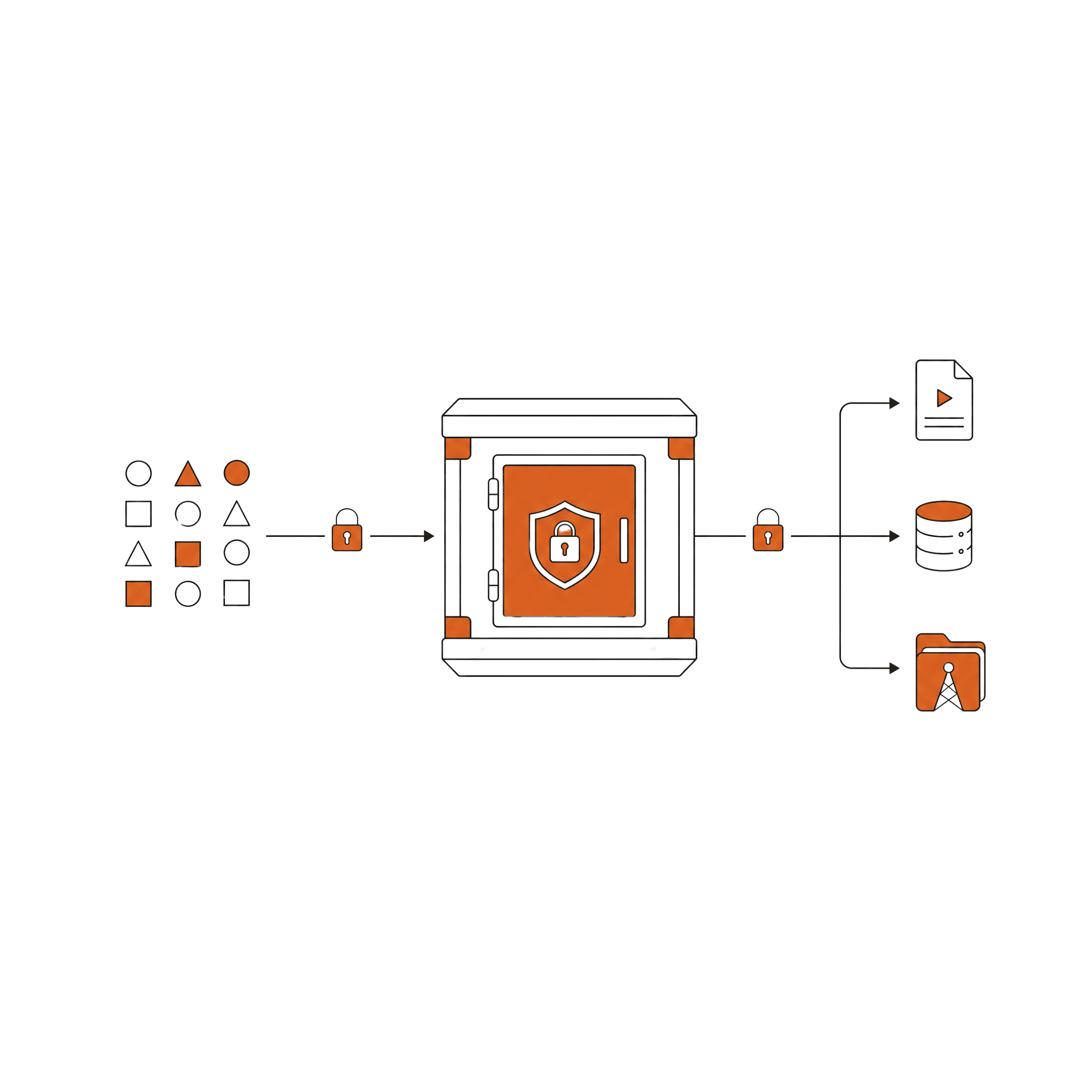
AI content pipelines connect multiple tools, usually a mix of language models, image generators, video tools, and automation platforms, into a single workflow. Each connection is a point where data flows in and content flows out. Each one is a place where security needs to be considered, not assumed.
The risks fall into a few categories that any founder running a content system should be aware of:
- Data privacy: what happens to your brand guidelines, customer data, and audience information once it enters an AI tool.
- Content quality and accuracy: how AI-generated content is reviewed before it reaches your audience.
- Prompt injection: when hidden instructions in documents or web content cause AI to behave in unintended ways.
- Supply chain risk: the security posture of every AI provider in the pipeline.
- Brand and reputational risk: what happens when AI-generated content goes wrong in public.
None of these are reasons to avoid AI content systems. They are reasons to choose carefully and ask the right questions of anyone building one for you.
Data Privacy in AI Content Pipelines
When you upload brand voice documents, customer testimonials, or audience research into an AI system, that data passes through third-party APIs. The privacy posture varies significantly between providers.
Enterprise API tiers from the major AI providers typically do not train on customer data by default. Consumer products often do. Smaller image and video generation tools have terms ranging from solid to permissive, and they change.
The privacy environment is tightening worldwide. The Privacy Act review in Australia, GDPR for European customers, and emerging AI-specific regulation in multiple jurisdictions all point in the same direction: more accountability for how customer data is processed, including by AI systems. Founders that get ahead of this now will spend less time retrofitting later.
Content Quality, Accuracy, and Output Validation
AI content is fast, but it is not always right. Models can produce confident-sounding claims that are inaccurate, off-brand, or in rare cases legally problematic. The Air Canada case, where a chatbot invented a refund policy and the airline was held liable, is the cleanest example of why output validation matters.
A well-built AI content pipeline does not publish directly from the model. It includes review steps that check for brand voice, factual accuracy, and policy compliance before anything goes live. The level of review depends on the content type and the stakes (a product feature claim needs more checking than a generic engagement post), but the principle is the same in every case.
Ask any AI content provider what their review process looks like. If they cannot describe it in concrete terms, the review probably is not happening.

Prompt Injection and AI Safety
Prompt injection is one of the most discussed AI security topics in 2026, and for good reason. It is when instructions hidden inside content (a brand document, a webpage, an external data feed) change how an AI model behaves. The model treats the hidden text as a command rather than as content.
For founders, this is less about dramatic attacks and more about subtle ones. A document with embedded instructions can quietly bias generated content, change tone, or insert specific phrasing across hundreds of outputs before anyone notices. Mitigating it requires careful pipeline design, including how documents are processed, how outputs are validated, and how AI tools are constrained.
The OWASP Top 10 for Large Language Model Applications and the OWASP Top 10 for Agentic AI are the leading frameworks for thinking about this. Any AI content provider worth working with is familiar with both.
Supply Chain Risk: The Multi-Provider Problem
A single AI content pipeline often uses several providers: one for copy, one for images, one for video, one for orchestration. Each provider has its own security practices, terms of service, and uptime record.
This is not a reason to use fewer tools. It is a reason to know which tools are in the pipeline, what they do with data, and what happens if one of them changes its terms or has an outage. The best-built pipelines have documented dependencies and fallback options for every critical link. The worst-built ones are silently fragile and only reveal it under pressure.
What to Ask an AI Content Provider About Security
If you are evaluating an AI content system or partner, these are the questions that separate serious operators from the rest:
- Where does our data go, who retains it, and for how long.
- Do any of the AI tools in the pipeline train on our data.
- How do you validate AI-generated content before it reaches our brand.
- What does the review step look like, and at what points does it apply.
- How do you handle prompt injection in client documents and external data.
- Which AI providers does the pipeline depend on, and what is the fallback if one changes.
- How will your security posture evolve as AI regulation develops.
If the answers are clear and specific, that tells you something. If they are vague, that tells you something too.
The Takeaway
AI content systems are no longer experimental. They are core content infrastructure, and the operators building them well are treating security as a foundational design question rather than something to address later.
For founders running content systems, the goal is not to become AI security specialists. It is to work with people who already are. The right partner builds AI content pipelines that move fast, protect client data, and produce content you can stand behind, every time.